
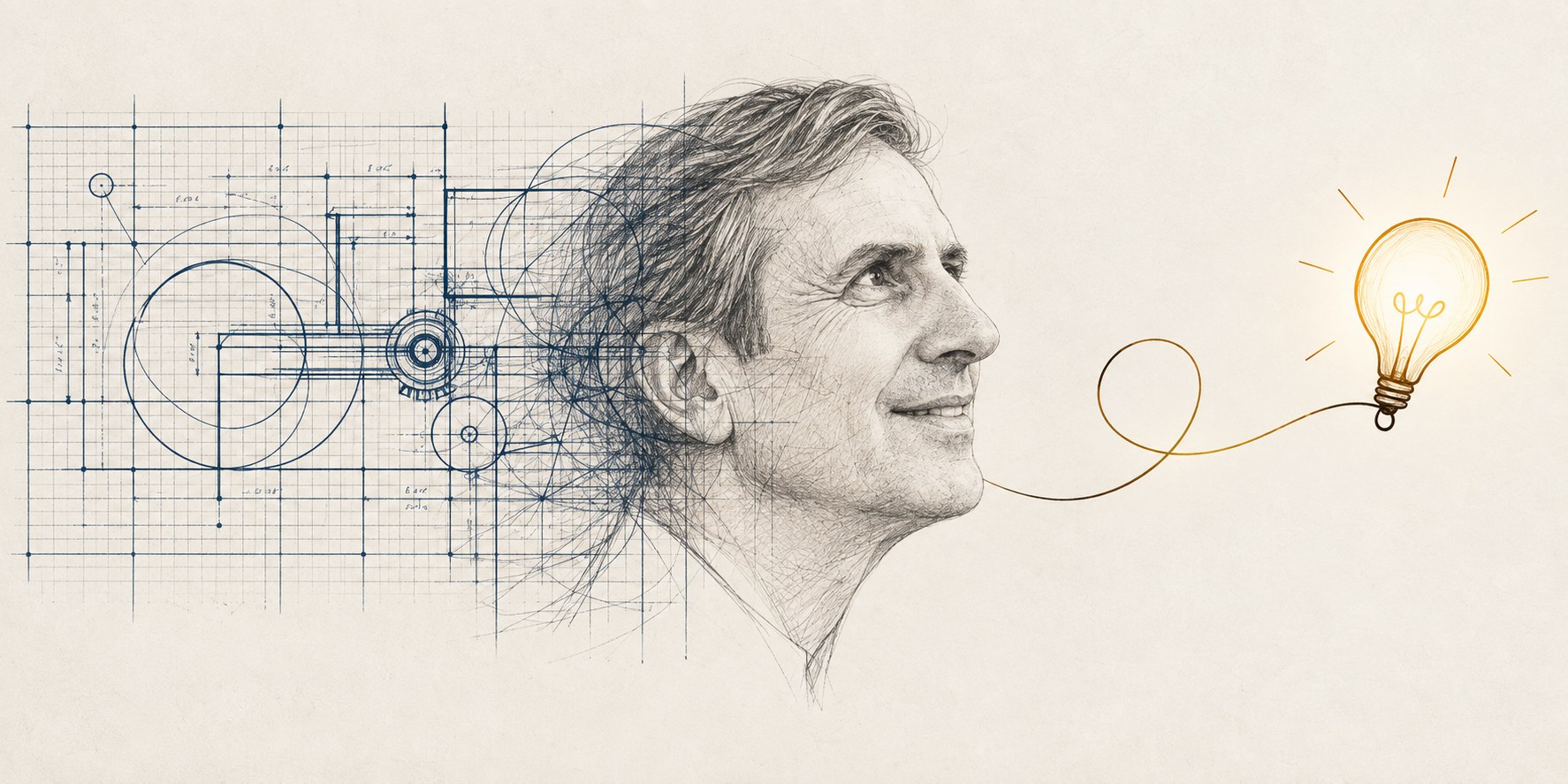
Jean-François Hirschel
I trained as an IT engineer at the Swiss Federal Institute of Technology (EPFL). More than 30 years later, after a career that has taken me from technology to finance and then to marketing, two questions still come up regularly: how does an IT graduate become a financial professional? And perhaps even more puzzling: how does an IT graduate end up in marketing?
These are often seen as changes in direction. Looking back, I see much more continuity than change. Two ideas have been present throughout: Human and Process. And, perhaps more importantly, the combination of the two has become central to the way I help clients today.
Human
When I was interviewing for my first job after graduation, I said something along these lines: “I am not interested in IT for the sake of IT. I am interested in what IT makes possible for people and businesses. I want to understand the activity first, then work out how technology can help people do it better and focus on what really matters.”
I only realised a few years later that this was probably the sentence that got me the job. It also turned out to be a fairly good description of how I would approach much of my career.
Technology may be built from code, systems and data, but making it useful requires understanding the people who use it: what matters to them, how they think, what frustrates them, how they make decisions and how they interact with others. That curiosity about people is also where the connection with marketing becomes obvious.
There are many definitions of marketing. Probably too many, which may be part of marketing's own marketing problem. One I particularly like comes from Youngme Moon, Professor of Business Administration at Harvard Business School, in her book “Different”: “Marketing is the only function within the organization that is expressly designed to sit at the intersection where business meets people. Real people. And the problem with real people is that they don’t see the world the same way a businessperson does. They don’t speak the language of bullet points; they don’t organize the world in flowcharts and frameworks.”
That intersection is particularly important in finance. The raw material of the industry is largely data, figures, analysis and facts. All of these are essential. But clients are still human. They need to understand what a firm stands for, why its approach matters to them and why they should care about one proposition rather than another.
This is a large part of what we do for clients at H-Ideas: start from the substance - the investment philosophy, capabilities, culture, evidence and ambitions - and translate it into a positioning that is both true to the organisation and meaningful to the people it wants to reach. Not replacing facts with emotion, but making the facts relevant to human beings.
The contrast with consumer brands can be striking. L'Oréal does not define itself simply by saying that it makes beauty products. Its purpose, “Create the beauty that moves the world”, connects what the company does with a broader human idea. Financial firms operate in a very different environment, of course, but the underlying lesson travels well: what you do matters and what it means to people matters too.
Process
The second thread is Process. Marketing is sometimes reduced to “the creative people who design the logo”. The logo matters, but it is a very small visible part of a much larger system: identity, positioning, client insight, propositions, messages, content, channels, implementation and measurement all have to work together.
Creativity therefore benefits from structure. A strong positioning should not emerge from a room full of adjectives and a vote for everyone's favourite. It should be built from evidence, choices and a disciplined process, while leaving enough room for the creative leap that makes the result distinctive and memorable.
This is where the engineer in me remains very much alive. Break a complex question into its components. Gather the right inputs. Separate assumptions from facts. Create a method. Test for consistency. Then turn the analysis into something clear and usable. It may not sound like the romantic version of marketing, but in my experience it is what allows creativity to produce business value rather than simply attractive output.
For clients, that combination matters. The human side helps uncover what is distinctive, relevant and emotionally resonant. The process side helps ensure that the result is grounded, coherent, shared by different stakeholders and capable of being implemented. One without the other is rarely enough.
And now, AI
Which brings me, rather neatly, back to technology. Artificial intelligence is becoming an increasingly important part of marketing, and we will soon have more to say as we introduce new services to help clients use AI to strengthen their distinctive identity in the market.
There is something quite satisfying about this circle closing. As an engineering student, I worked on things like machine learning, neural networks or pattern recognition. They were intellectually fascinating but often of limited practical use: there was not enough data to feed them and not enough computing power to make them truly useful. Today, those same underlying ideas have become extraordinarily powerful tools.
But the principle has not changed. Technology is most valuable when it serves a clear human purpose and when it is applied through a thoughtful process. AI can accelerate analysis, challenge thinking, generate possibilities and improve execution. It does not replace the need to understand the people a business serves or what makes it genuinely different.
And yes, I did use AI for this article
One final question you may be asking: was this article written by AI?
The first version was written by me. I then used AI to improve the readability and structure and to make it more relevant for the reader. The ideas, experience and point of view are mine; the technology helped me express them better.
Human in mind. Process in execution. Technology where it helps. In the end, perhaps my career path is more consistent than it first appears.