

Is ChatGPT really replacing fund selectors?
A year ago, the answer seemed straightforward: AI was an impressive assistant, but no substitute for experienced fund selectors. Twelve months later, that answer is becoming much harder to give.
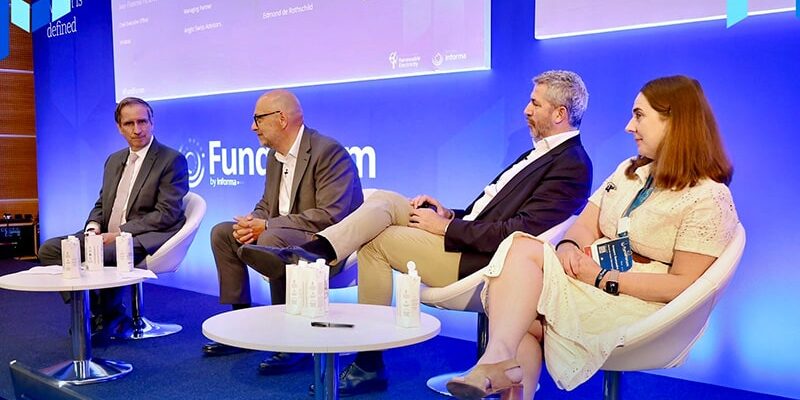
At Fund Forum 2026, Laurent Auchlin (Anglo Swiss Advisors), Pierre Bonart (Edmond de Rothschild) and Amparo Sampedro (Generali Asset Management) reunited to revisit the discussion they had at last year’s conference, moderated by Jean-François Hirschel (H-Ideas). Their conclusion was clear: AI has progressed dramatically in just one year. But rather than replacing fund selectors, it is fundamentally changing how they work.
From junior analyst to research partner
Last year, the panel agreed that AI had already surpassed a junior analyst in many routine research tasks. This year, they described another leap forward.
AI is more reliable, more proactive and far better at engaging in a genuine dialogue. Rather than asking isolated questions, professionals increasingly use AI as a research partner: challenging assumptions, identifying blind spots and suggesting alternative perspectives before investment decisions are made.
Yet the panel remained unanimous on one point: judgement cannot be automated.
Just as aircraft have relied on autopilot for decades without eliminating pilots, fund selection still requires experienced professionals to navigate situations that fall outside historical patterns. Those rare events may be precisely the ones that matter most for investors.
The real disruption is organisational
Perhaps the biggest change over the past year has not been technological, but cultural.
Many analysts initially saw AI as a threat to their jobs. Today, they most increasingly view it as a tool that makes them better at their job. As one panellist observed, the people most at risk are not those replaced by AI, but those who choose not to use it.
For organisations, however, this creates a different challenge. AI evolves faster than corporate processes. Compliance, governance, HR policies and operating models must adapt with unprecedented speed. In this environment, agility and pragmatic decision-making become competitive advantages.
Will everyone end up making the same decisions?
If everyone relies on the same AI tools, will portfolios eventually become identical?
The panel acknowledged the risk. Just as job applicants optimise CVs for automated screening, asset managers are beginning to tailor their due diligence material for AI consumption.
This makes human judgement even more valuable.
The best investment decision is not simply the one AI considers optimal. It is the one that best reflects the objectives, constraints, values and psychology of a specific client. Asking the right questions and interpreting the answers in context remains a distinctly human skill.
The industry’s next responsibility
The discussion ended with a broader concern.
If AI can perform much of the work traditionally assigned to junior analysts, firms may be tempted to reduce graduate hiring. But where, then, will tomorrow’s senior investors acquire the experience, intuition and judgement that AI cannot replicate?
The panel’s conclusion was that the industry must resist the temptation to optimise only for short-term efficiency. Developing the next generation of investment professionals is not simply a talent issue, it is essential to ensuring that AI remains a tool guided by experienced human judgement, rather than a substitute for it.


